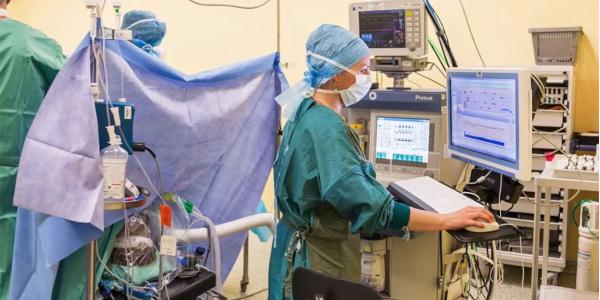




The Future of Anesthesia: How UCSF is Working to Make Surgery Safer
Researchers Jason Sello, PhD, Jarret Weinrich, PhD, and Matthew McCarroll PhD, are working to develop a new generation of anesthetics that are significantly safer and more stable.
Research in the Department of Pharmaceutical Chemistry focuses on understanding fundamental biochemical mechanisms underlying health and disease, which are key to developing new and more effective diagnostics and medications. See all of our research areas.
Chemical biologists create chemical tools and methods to probe and dissect biological systems. This work provides insights crucial to the medicinal chemists’ rational design of small molecule drugs to alter the activity of these pathways, resulting in potential therapeutic benefit.
Researchers in this area use computer programs to model, predict, visualize, and analyze the structures, functions, and interactions of biologically important molecules. These include proteins and potential small molecule drugs and the cellular networks they engage.
Department physical biologists develop and apply techniques to identify, quantify, and visualize biologically relevant molecules.
Protein engineers alter, design, and synthesize protein molecules to understand and generate new functions, to monitor biological processes, and to provide new therapies. Department cellular engineers generate tissues with specific cell types to study intercellular and tissue-to-cell signaling in health and disease.
200+
Department of Pharmaceutical Chemistry researchers published over 200 papers in 2024, spanning topics such as drug discovery and proteomics. Visit our curated list of recently published papers.
46th year
In 2025, and for the 46th consecutive year, the UCSF School of Pharmacy received more research funding from the National Institutes of Health (NIH) than any other pharmacy school.
150+
Our patents underscore a culture of innovation — turning fundamental discoveries into impactful, first‑in‑class solutions that deliver true novelty and real‑world impact.
Through our research, we facilitate access to shared services and facilities across the campus, playing a vital role in providing resources and support to the broader scientific community. See all of our research services and facilities.
Researchers Jason Sello, PhD, Jarret Weinrich, PhD, and Matthew McCarroll PhD, are working to develop a new generation of anesthetics that are significantly safer and more stable.
Charles Craik, PhD, and his colleague Anthony O’Donoghue, his former postdoc, help as many researchers as they can with a new tool they developed for analyzing enzyme activity. To meet the growing demand, they realized the technology needed a home beyond academia and founded Alaunus Biosciences.
James Fraser, PhD, Brian Shoichet, PhD, and Balyn Zaro, PhD, have all been selected to join the Collaborative Research Network (CRN), an international consortium supported by Aligning Science Across Parkinson's (ASAP) in partnership with The Michael J. Fox Foundation for Parkinson's Research that aims to better understand Parkinson's disease and speed the development of future treatments.